BOOK REVIEW OF
The Midnight Library
Matt Haig
Reviewed by Ella Law (with Gemini & NotebookLM)
Published January 17, 2026
Table of Contents
Content Rating
CSR Rating: CSR-3 (Teen & YA – Contains Mature Themes).
Content Warnings (CW): 💔 Suicide/Self-Harm, 🧠 Mental Health (Depression, Anxiety), ⚰️ Death & Grief (Parental loss, pet death, death of a friend), 💊 Addiction/Substance Abuse (Alcoholism)
The narrative catalyst is the protagonist, Nora Seed, deciding to end her life by taking an overdose of antidepressants. Throughout the book, there are references to “situational depression” and panic attacks. Additionally, addiction is a recurring theme; characters struggle with alcoholism, including Nora’s mother, her brother Joe, and her former fiancé Dan, who uses alcohol to cope with stress. The story also depicts the grief of losing parents and the sudden death of a pet cat, Voltaire.
📖 Introduction & Why This Book Matters
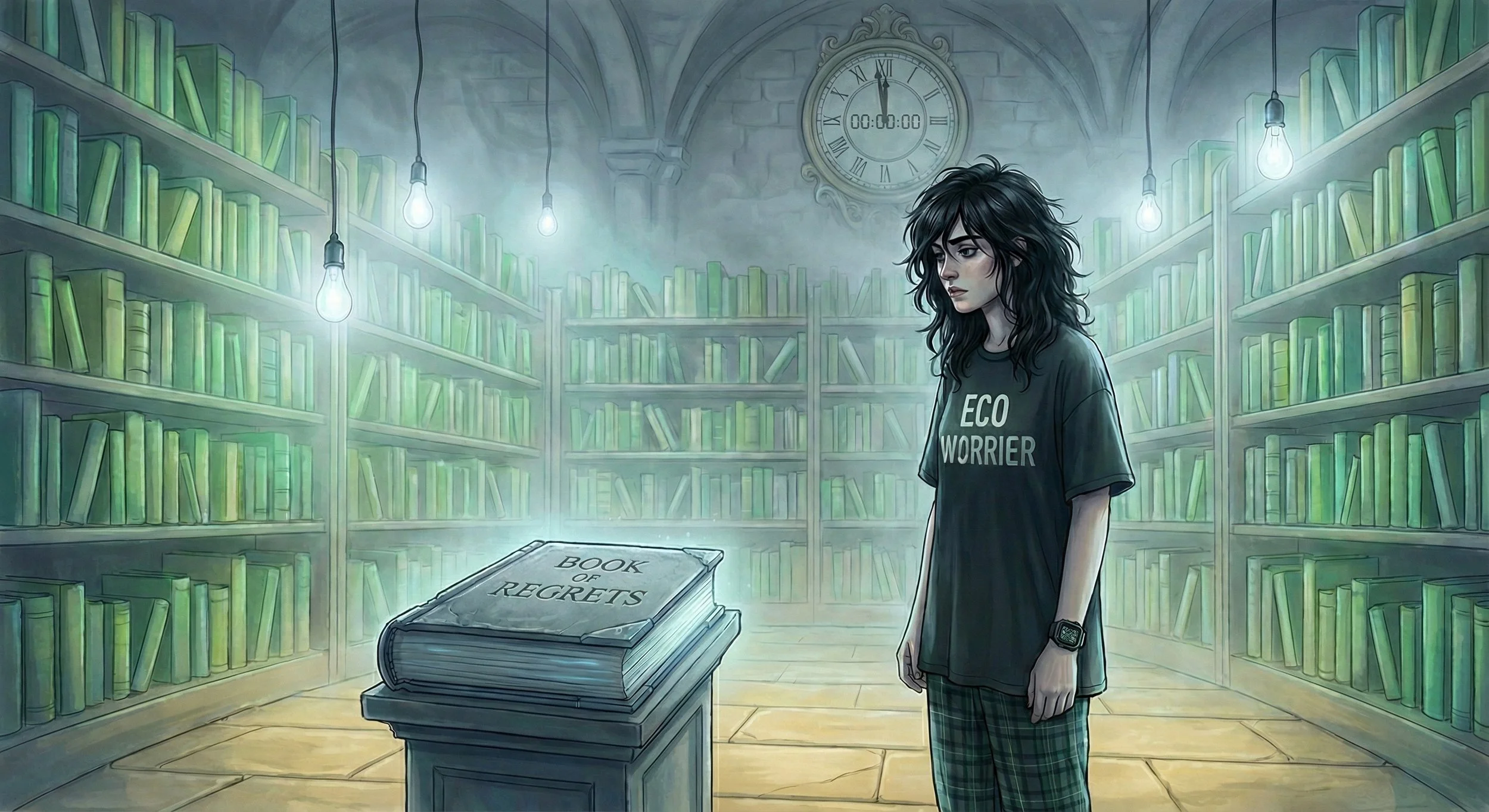
Have you ever felt trapped by the ghosts of the lives you didn’t live? The Midnight Library explores the universal human experience of regret—the haunting question of “what if?” This isn’t just a story about time travel or parallel universes; it is a philosophical inquiry into what makes life meaningful. The narrative suggests that between life and death there is a library where the shelves go on forever, and “every book provides a chance to try another life you could have lived”.
This book matters because it dismantles the paralyzing conviction that we have no agency. It challenges the reader to look at their own “Book of Regrets” and question whether the grass is truly greener in a different timeline. It resonates deeply because it shifts the focus from external achievements—like winning Olympic medals or becoming a rock star—to the internal landscape of acceptance and connection.
✍️ Plot Summary
Nora Seed is a thirty-five-year-old woman living in Bedford who feels she has nothing left to live for. Her life seems to be a catalogue of failures: she has backed out of a wedding to her fiancé Dan, quit a promising swimming career, left her band The Labyrinths just before they hit it big, and recently lost her job at a music shop called String Theory. When her beloved cat, Voltaire, is found dead on the roadside, Nora decides she can no longer endure her existence and attempts suicide.
Instead of dying, Nora wakes up in a mysterious library where the time is always 00:00:00. She is greeted by Mrs. Elm, her childhood school librarian, who offers her a unique opportunity: the chance to “undo your regrets”. Nora is given access to an infinite number of books, each containing a different version of her life had she made different choices. From owning a country pub to researching glaciers in Svalbard, Nora slips into these varied existences to see if she can find the one perfect life where she is truly happy. But as the library becomes unstable, Nora must decide what she truly wants before her time runs out.
💡 Key Takeaways & Insights
1. Regret is often a matter of perspective, not fact. One of Nora’s deepest regrets is that she was a bad pet owner who caused her cat’s death by letting him outside. However, when she visits a life where she kept the cat indoors, she discovers he still died of a heart condition he was born with. This teaches her that we often torment ourselves with “bullshit” regrets over outcomes we never actually had the power to control.
2. Living for the dreams of others is a path to loneliness. Nora visits a life where she didn’t quit swimming and became a double Olympic gold medalist. While this life fulfilled her father’s dream, Nora finds herself lonely, exhausted, and estranged from her family in different ways. She realizes that “success isn’t something you measure, and life isn’t a race you can win,” and living solely to impress others leads to a hollow existence.
3. Small acts of kindness can anchor us. While Nora experiences lives of grandeur, the life that tempts her to stay the most is built on a foundation of simple kindness. In her “root” life, a surgeon named Ash helped bury her cat—a small act of compassion. In a different life, this connection leads to a loving marriage and a daughter. This reminds us to never underestimate the great importance of small things.
4. Survival impulses can clarify our desires. Nora believes she wants to die until she is faced with imminent death by a polar bear in the Arctic. In that moment of extreme crisis, she realizes she is terrified of dying, screaming “I DON’T WANT TO DIE”. This epiphany reveals that her suicidal ideation was born of despair (believing there was no way out) rather than a genuine lack of will to live.
5. We are “sliders” in our own perceptions. Nora meets Hugo, another “slider” who travels between lives but never settles. Through this, she learns that constantly seeking a “better” life prevents you from living the one you are in. She eventually understands that she doesn’t need to access every potential version of herself to be complete because “we don’t have to do everything in order to be everything, because we are already infinite”.
🤯 The Most Interesting or Unexpected Part
The most unexpected twist occurs when Nora finally finds the “perfect” life. She is a philosophy professor at Cambridge, married to the kind-hearted Ash, has a beloved daughter named Molly, and owns a dog named Plato. On paper, this is the resolution to all her pain. However, she ultimately chooses to leave this utopia. Why? Because she feels like a fraud. She realizes she “hadn’t earned this” and was merely “carbon-copied into the perfect life” that a different version of herself had built. It is a profound subversion of the happy ending trope; she rejects a perfect reality because she lacks the memories and struggles that forged it, proving that ownership of one’s chaotic, messy journey is more valuable than parachuting into unearned happiness.
🏛️ How This Book Applies to Real Life
The Midnight Library serves as an allegory for the modern condition of “FOMO” (Fear Of Missing Out) and the paralysis caused by social media comparison. Nora notes early in the book that she “sat on her dilapidated sofa scrolling through other people’s happy lives,” fueling her sense of inadequacy. That every book in the library is a shade of green makes the point that the grass is rarely greener; it’s just a different shade of green.
Who should read this?
The “What If” Worriers: Anyone who loses sleep obsessing over past mistakes or “roads not taken.”
Those feeling “stuck”: Readers experiencing career burnout or a quarter/mid-life crisis.
Philosophy Enthusiasts: The book references Thoreau, Sartre, and Camus, making it a light but engaging philosophical treatise.
Fiction Lovers needing uplift: Those who want a story that acknowledges darkness but ultimately affirms life.
📚 Final Rating: 4.0/5 Stars
This book is a compelling exploration of mental health and the human condition, offering “gentle insights and soothing wisdom”. While the protagonist, Nora, can occasionally be insufferable in her initial pessimism, and the narrative device of visiting different lives becomes slightly repetitive, the story delivers powerful themes about finding meaning in a messy existence.
🎯 Should you read it? Yes, with nuance. If you are looking for a highly original sci-fi mechanic, this might feel a bit soft; the “library” is clearly a metaphor for the brain processing trauma. However, if you are looking for a heartwarming, life-affirming story that tackles depression without being overly bleak, this is an excellent choice.
🔥 Final Thought As Nora discovers after living a thousand lives, you don’t need to understand or optimize life to enjoy it; you just have to decide to live it.